Artistry in Bossa Nova
LABEL Capitol
NO. ST 1931
FORMAT 12” Record
PRODUCER Lee Gillette
LINER NOTES Noel Wedder
PHOTO CREDIT Elliott Erwitt
LOCATION Capitol Tower Studios, Hollywood
RECORDING DATE 16-17 April 1963
… subtle rhythms and a powerhouse orchestra
ARTISTRY IN BOSSA NOVA FROM THE CREATIVE WORLD OF STAN KENTON
The rhythmic fascination of Latin-American music, complemented by the expressive force of the Kenton orchestra, is a familiar combination to jazz aficionados. Yet these twelve Kenton instrumentals—some old, some new, all scored by Stan in bossa nova rhythms—are as refreshing as a cool rum drink on a hot afternoon. The reason: the sum of Kenton and bossa nova adds up to even more than its parts.
Even before 1949, the year Stan Kenton vacationed in South America, a composition by Stan and Pete Rugolo entitled Machito gave an indication of the exciting influence Latin music was to have on Kenton eras to come. But the listening and studying that Stan did during that six months visit sealed the issue, and ever since the Latin sound has been prevalent among Kenton arrangements.
It is not surprising then that when Stan’s 40-piece string-oriented orchestra made its debut at the Los Angeles Philharmonic on January 30th, 1950, its repertoire included three original compositions by the famed Brazilian concert guitarist, Laurindo Almeida, who had joined the Kenton band in 1948. Even then, Stan was feeling the importance of including in the band’s library segments of the form we now, thirteen years later, have come to call bossa nova.
Here now is the way the band plays it in 1963 ... subtle rhythms and a powerhouse orchestra…twelve of Stan's finest arrangements yet …Stan Kenton's “Artistry in Bossa Nova.”
side one:
ARTISTRY IN RHYTHM • Stan's theme, which he composed in 1941, is an ever fine display piece for the mobility and discipline of the sections. Here the Latin undercurrent brings still a new degree of excitement to this outstanding favorite.
OPUS IN CHARTREUSE • Stan's new bossa nova arrangement of Gene Roland's graceful tone poem contrasts the reeds and piano in a pastel style against the more dominant brasses, and the lazy Brazilian rhythm.
INTERLUDE • This beauty displays the liquid calm of the trombones, working against bossa nova rhythm in skillful interplay with the Kenton piano.
KENTONOVA • A new Kenton original, powerfully conceived, with saxes and trombones held to close quarter by Stan's declarative piano, punctuated by frequent bursts of color from the brass section.
EAGER BEAVER • The Kenton favorite of the swinging big-band days now becomes a jazz samba, and even gains in the translation.
CONCERTO TO END ALL CONCERTOS • An innovation when Stan wrote it back in the late forties, and still an innovation. Concerto, bossa nova style.
side two:
BRASILIA • Composed especially for this album by Stan, this new Kenton invention conveys the very essence of the Brazilian jazz samba, as arranged for large, modern orchestra.
PAINTED RHYTHM • Another old favorite set in the Latin concept, with Stan's piano playing the opening chorus, followed by precise section work, with Dalton Smith's trumpet, now breaking loose, now blending in.
OPUS IN PASTELS • As in Stan's original arrangement, written over two decades ago, this again is a showcase for the assertive, full-throated sound of the sax section.
JUMP FOR JOE • This tribute to disc jockey Joe Rico was written on a plane by Gene Roland in 1951, while the band was flying from Canada to Seattle for an engagement. Conte Candoli's trumpet solo is featured in Stan’s new bossa nova arrangement.
LOCO-NOVA • A new Kenton composition and arrangement, this evolves around Candoli’s tongue-in-cheek, crazy-like, or “loco," trumpet solo, and frantic work by the sections.
ARTISTRY IN BOSSA NOVA • This new arrangement is patterned by Stan after Pete Rugolo’s original composition, “Artistry in Bolero.” The mood is still Ravel-like, but the tempo is bossa nova, as Bob Fitzpatrick's soulful trombone blends with the Kenton sections.
—from an essay by Noel Wedder
Reviews

John S Wilson. "Record Review. Artistry in Bossa Nova (Capitol)." Down Beat. 26 September 1963. 22.
ARTISTRY IN BOSSA NOVA—Capitol 1931 : Artistry in Rhythm; Opus in Chartreuse; Interlude: Kentonova; Eager Beaver; Concerto to End All Concertos; Brasilia; Painted Rhythm; Opus in Pastels; Jump for Joe; Loco-Nova; Artistry in Bossa Nova
Personnel: Dalton Smith, Bud Brisbois, Conte Candoli. Bob Behrendt, Bob Rolfe, trumpets; Bob Fitzpatrick, Kent Larsen. Gilbert Falco, trombones; Dave Wheeler, Jim Amlotte, bass trombones: Dwight Carver, Joe Burnett, Bob Crull, Tony Scodwell, mellophoniums; Gabe Baltazar, alto saxophone; Steve Marcos, Ray Florian, tenor saxophones; Jack Nimitz, baritone Saxophone; Joel Kaye, bass saxophone; Kenton, piano; Don Bagley, bass; Dee Barton, drums; Frank Guerrero, Milt Holland, Latin percussion.
Rating: ★ ★ ★ ★
Kenton's venture into bossa nova might at first glance. seem to be a measure of desperation—every time he seems to run out of ideas for a record he has a habit of re-examining those hits from the ‘40s on which he built his popular reputation. He has redone them in high fidelity and stereo, with strings, and now in bossa nova. And, by and large, the results this time are surprisingly satisfying. The old Kenton melodies adapt readily to a bossa nova backing, particularly Interlude, Artistry in Rhythm, and. unexpectedly, Eager Beaver. Moreover, the very nature of the tunes and the rhythmic setting imposes a sense of shading on the band that has been glaringly absent from the post-'40s Kenton works.
This version of the Kenton band proves that it is quite capable of varying its levels with sensitivity. The result is a feeling of warmth, of human beings at work, that one has missed in most of the mechanical and torrential sounds that have roared out of the Kenton crew in the last decade. The combination of bossa nova and a big band is not always felicitous but even though Kenton's rhythm section sometimes becomes a bit heavy in this context. the arrangements break down to piano and rhythm or what is essentially a small group and rhythm to such a great extent that the rhythm section is usually able to bold to proper airiness.

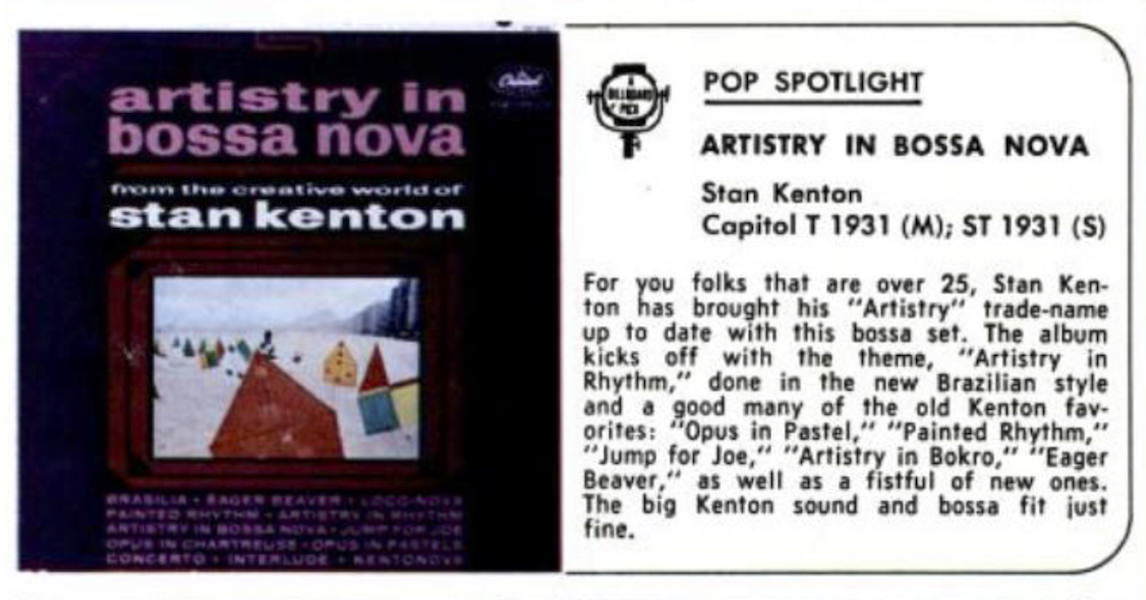
POP SPOTLIGHT
ARTISTRY IN BOSSA NOVA
Stan Kenton
Capitol T 1931 (M): ST 1931 (S)
For you folks that are over 25, Stan Kenton has brought his “Artistry” trade-name up to date with this bossa set. The album kicks off with the theme, “Artistry In Rhythm,” done in the new Brazilian style and a good many of the old Kenton favorites: “Opus In Pastel,” “Painted Rhythm,” “Jump For Joe,” “Artistry In Bolero,” “Eager Beaver,” as well as a fistful of new ones. The big Kenton sound and bossa fit just fine.
“Record Review. Artistry in Bossa Nova.” Billboard 15 Jun. 1963: 29.
Stan Kenton and his Orchestra:
“Artistry In Bossa Nova”
(Creative World Inc.).
Artistry In Rhythm / Opus In Chartreuse / Interlude / Kentonova / Eager Beaver / Concerto To End All Concertos / Brasilia / Painted Rhythm / Opus In Pastels / Jump For Joe / Loco-Nova / Artistry In Bossa Nova.
A SELECTION of well-remembered compositions by Pete Rugolo, Gene Roland and Kenton himself, recorded in April 1963 and thus benefiting from the by then vastly improved recording techniques, as compared to those existing between 1941 and 1947, when earlier recordings of most of the same items had been made.
This was the orchestra that came to Britain later in the same year, and how fresh and modern it all sounds nine years later! All arrangements are by Kenton and, unlike current trends, the dynamics are orchestrally created—independently of the control panel.
I first met Stan Kenton early in 1956 during the first Anglo/American exchange (with the Ted Heath Orchestra), and then, as well as at later meetings in subsequent years, was struck by the marked contrast between his polished and almost gentle off-stage charm as compared with the ferocity he seemed to exude when in front of that orchestra—whipping up the proceedings from a sensitive pianissimo to the most shattering of fortissimos and back. A great sound.
—Harry Francis.
Harry Francis. “Record Review. Artistry in Bossa Nova.” Crescendo International. November 1972. 29.
Tracks
1. Artistry In Rhythm (Stan Kenton)
solo: Kenton (p)
2. Opus In Chartreuse (Gene Roland)
solo: Kenton (p)
3. Interlude (Pete Rugolo & Bob Russell)
solo: Kenton (p)
4. Kentonova (Stan Kenton)
solos: Kenton (p) Brisbois (tp)
5. Eager Beaver (Stan Kenton)
solo: Kenton (p)
6. Concerto To End All Concertos (Stan Kenton)
solo: Kenton (p)
7. Brasilia (Stan Kenton)
solo: Kenton (p)
8. Painted Rhythm (Stan Kenton)
solo: Kenton (p)
9. Opus In Pastels (Stan Kenton)
solo: Kenton (p)
10. Jump For Joe (Gene Roland)
solo: Candoli (tp)
11. Loco-Nova (Stan Kenton)
solos: Kenton (p) Candoli (tp)
12. Artistry In Bossa Nova (Artistry In Bolero) (Pete Rugolo)
solos: Kenton (p) Fitzpatrick (tb) Brisbois (tp)
All tracks arranged by Stan Kenton.
Personnel
Alto sax
Gabe Baltazar
Tenor sax
Steve Marcus
Ray Florian
Bari sax
Jack Nimitz
Bari & bass sax
Joel Kaye
Trumpet
Bud Brisbois
Dalton Smith
Bob Behrendt
Conte Candoli
Bob Rolfe
Mellophonium
Dwight Carver
Tony Scodwell
Joe Burnett
Bob Crull
Trombone
Bob Fitzpatrick
Kent Larsen
Gil Falco
Jim Amlotte (b-tb)
Dave Wheeler (b-tb, tuba)
Piano
Stan Kenton
Bass
Don Bagley
Drums
Dee Barton
Percussion
Frank Chico Guerrero
Larry Bunker
Milt Holland (replaces Bunker on tracks 2, 4, 8, 12)