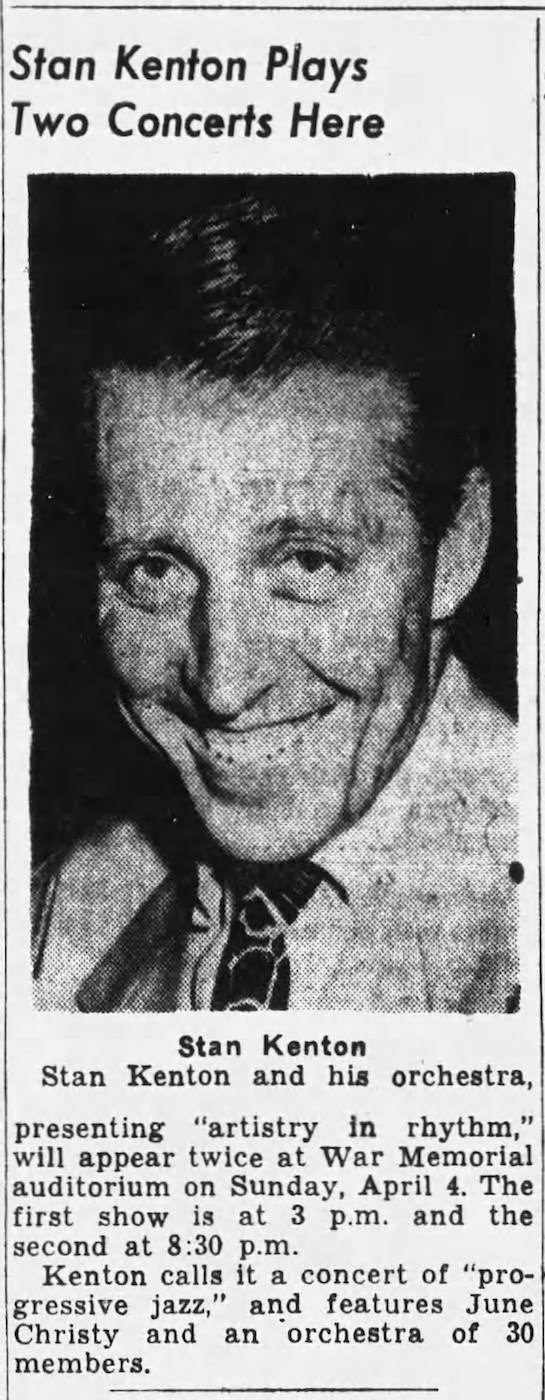
New York—Before a jam-packed Carnegie Hall mob with enough energy left at 2:30 a.m. to scream its approval when a return concert was announced, Stan Kenton’s 20-manned music-maulers broke it up here last month.
With over $8,000 in the till, cops struggling with the lobby overflow and a stage crammed with musicians and 300 sit-and- standees, Kenton started his effort to prove to this town and the country that the proper place for a band such as his is in the concert hall rather than the dance hall.
From the initial Artistry Jumps to the Concerto To End All Concertos, 32 tunes later, the lean leapo of jazz had the crowd right in the palm of his hand.
Slightly at variance with his sincerely-stated seriousness of musical purpose was some gagging with Ray Wetzel towards the end of the first half, and a long vaudeville sequence with members of the band at the end, running from name imitations to a Kenton St. James Infirmary vocal punctuated by Bart VarsaIona’s doing a George Brunis parade march, while playing Artistry Jumps on his trombone. The crowd accepted the spoofing in good spirit, even though for pace’s sake it might better have occurred earlier in the program.
Heard throughout ·the program were indications of the changes Kenton mentioned in his long interview with this writer in the January 14 Beat.
Better Dynamics
Particularly on Bob Graettinger’s score of You Go to My Head could be heard a type of dynamic control and scored polyphony that Kenton has sorely lacked, while his Thermopylae and Pete Rugolo’s Prologue Suite made particularly ingenious use of brass as a secondary rhythm section. The latter also had an effective punctuation device of piano versus bongos with both repeating a previously stated theme.
Outstanding solos: Art Pepper ‘s bop-styled alto, the similarly-flavored tenor of Bob Cooper, who was lost in a typically bad Carnegie Hall mike set-up for the first few numbers, Milt Bernhart’s pashful tromboning, Ray Wetzel’s chorus on Now He Tells He and Laurinda Almeida’s superbly tasteful guitar on Lament.
Great Rhythm
The rhythm section was consistently spectacular throughout, Safranski’s frenzied bassing leaving spectators worrying about eventual neuritis, and Shelly Manne’s drumming at its loud but enthusiastic best. Manne incidentally displays an at-homeness with non-four-four beats on Monotony (where he plays 3-3-5 sequences) which speaks well for his future development.
June Christy bowed on to How High the Moon, went through Willow Weep for Me, I Told Ya, I’ll Remember April, Rika Jika Jack, Don’t Worry ‘Bout Me and a well-received Lonely Woman. Last-named, a Benny Carter tune, was scored by Pete Rugolo and Kenton to show what the girl could do with good material and fine scoring not limited to steady meter patterns. She came off in good shape, though the improved intonation was marred by some faulty phrasing and obvious breathing.
Sections Improved
Improvement in the band’s section work was marked. The trombones are beginning to have a truly distinctive and almost single-tone section “sound”, while the trumpets are fuller-toned and less strident. Reed section changes could be particularly spotted in Opus in Pastel where comparatively new leadman George Weidler demonstrated how much freer-flowing and more jazz-inspired is the present sax section than was that of three or four years ago. Weidler in his solo, Elegy for Alto, displayed the same ability but added a tendency to play sharp.
Harlem Folk Dance, a traditional Kenton fave, was done, slightly rewritten, as Message to Harlem, while Machito was performed minus the trumpet-trombone unison which marred record.
Ping!
Newest instrument in band’s collection is the triangle, artistically whomped by Shelly Manne during four or five numbers on the program.
Carnegie Hall cooperated as usual by furnishing one dead mike, one that was constantly too high and hummed, plus a spotlight man who was always four bars too late. In spite of these handicaps, the Kenton band sounded better than many units which have played in the hall, partially because of close seating and bunching the reeds, rhythm and trombones while spreading the trumpets in raised seating back of the rest of the band.
Newies Satisfy
From an audience standpoint, the concert was a complete success. They heard everything they knew, a few simple new items and a couple of more complicated works which perhaps eluded them, but at least kept them from saying that the band was playing the same old baloney.
Technically, the performance was better than most Kenton has put on. Clams were few and far between, with only two out-standing cases of misreading in the trumpets and reeds being noted, while blend was better than usual. The band, once it starts moving, still pays no attention to dynamics, still has a firmly unbending feel to it which can become wearing over a whole evening.
Carves Old Band
However, there can be no questioning the fact that from the standpoint of soloist and ensemble alike, this band is three times as good as the band Kenton had a year ago. Also that its arranging staff is fumbling with some excellent ideas, in at least three cases hit a modified jack-pot.
Judgment as to whether this concert was the start of a new career for the Kenton band or merely a brilliantly-organized display of all it has to offer for now and evermore will have to wait for the coming year.
Kenton himself remains the most popular, most colorful and perhaps the best-liked figure in jazz today regardless of the eventual disposition of his music. —Michael Levin